
When a bank closes its books, another process begins. Every position runs against thousands of scenarios to answer one question: if the market moves against us, how much do we lose?
The calculation takes hours, so it runs overnight. The answer arrives the next morning. Until then, the desk is working from yesterday’s picture. That delay has existed for so long that it’s often treated as a condition of the business.
It may instead be a condition of the infrastructure beneath it.
In a representative financial services pipeline, DDN reported completing 64 billion risk simulations in two minutes. That internal result doesn’t predict what every institution will achieve. It shows that a process long defined as an overnight job can move into an entirely different decision window once data reaches compute fast enough.
That’s the challenge DDN and Cisco are addressing together. DDN Infinia has been validated in a published Cisco architecture as a software-defined data layer running on Cisco UCS and connected through Cisco Nexus One. It integrates into the infrastructure model customers already use for Cisco compute. Reference designs cover financial services, healthcare, and manufacturing.
Cisco provides the compute, network, and operational foundation. DDN provides the data engine: the software that turns the data tier into a high-performance AI data platform. The architecture addresses the part of an AI deployment customers have too often been left to assemble on their own.
Capacity Is Not Output
Nearly every enterprise AI conversation of the past two years has centered on compute: how many accelerators, which generation, what the power envelope requires. Gartner forecasts worldwide AI spending of $2.7 trillion in 2026, yet accelerator counts describe capacity, not production.
Even advanced machinery underperforms when raw material arrives late or in the wrong form. For AI, that raw material is data. It has to be ingested, organized, found, retrieved, and moved across a network before a model can use it.
The utilization data underscores the issue. In a June 2026 survey of 573 technical leaders, VentureBeat Research found 83% of enterprises operating their own GPUs reported utilization of 50% or less, and only 44% said they rigorously track the cost and return of their AI compute. The economic concern is that organizations pay for capacity even when much of it goes unused.
Low utilization has many causes: small workloads, poor batch sizing, and inefficient scheduling. One less visible cause is data delivery: accelerators may be waiting for work to reach them. A May 2026 VentureBeat analysis reached the same conclusion from the buyer’s side: for the largest enterprises, getting GPUs was rarely the real constraint. Data gravity, governance, and immature architecture were.
AI Demands Many Things from Storage
AI places several different demands on the data layer, often at the same time.
Training may require enormous sequential bandwidth to keep large numbers of GPUs supplied. Checkpointing can create bursts of heavy write traffic. Data preparation and retrieval introduce millions of metadata operations alongside small, irregular reads. Inference and RAG add concurrency, since many users and applications may be searching the same data simultaneously.
Consider a model asked why a component repeatedly fails in a particular climate. The model doesn’t know the answer. It searches the company’s maintenance records, engineering documents, and sensor history, retrieves the small set of records relevant to the question, and constructs a response. Multiply that process across thousands of users and agents, and the data layer has to find and deliver many small pieces of information with almost no delay.
Speed is only part of that requirement. Without appropriate access controls, an agent authorized to retrieve maintenance records may also access adjacent information. VentureBeat research found that 72% of enterprises lack the control over their AI environments, especially when it comes to security. As agents move into production, governance must be designed into the data layer, including controls over which models and agents can access which data.
Traditional enterprise storage was often optimized for a narrower job such as moving large files efficiently or preserving data economically. It can post a strong throughput number and still become an AI application bottleneck. Throughput still matters, but it isn’t sufficient on its own. An AI data platform has to combine bandwidth, request rate, metadata performance, concurrency, and latency. No single storage number tells the whole story.
The Data Platform Lives on Cisco Infrastructure
DDN Infinia runs on Cisco UCS — not alongside it, on it.
Infinia is software deployed on Cisco UCS C225 M8 rack servers. Those servers hold and serve the data, removing the need for a separate storage array behind them or a second hardware refresh cycle around the data tier. That gives the customer one hardware floor, from the GPU servers to the data tier.
In the broader reference architecture, Cisco N9300 switching connects the environment at leaf and spine, using RoCE on the storage fabric with four 200-Gigabit Ethernet connections per node. At the spine, the Nexus 9364E-SG2 provides switching capacity across 64 ports of 800-Gigabit Ethernet. Alternatively, N9348D-GX2A , providing 25.6 Tbps switching capacity, or N9332D-GX2B, providing 12.8 Tbps switching capacity, can also be used. The underlying UCS infrastructure, including the servers carrying the Infinia data tier, remains manageable through Cisco Intersight alongside the rest of the customer’s compute estate.
The broader architecture pairs that data tier with Cisco UCS C845A M8 GPU servers and C225 and C245 M8 client nodes — a defined path across accelerator compute, the data platform, and the fabric connecting them, with DDN software turning Cisco infrastructure into the system that continuously supplies AI workloads with data. The result is one data path from storage to GPU, and one operating model for the teams who run it.
A published reference architecture provides customers with a tested starting point, engineering teams with a repeatable deployment pattern, and Cisco and DDN with a common foundation for production. The customer isn’t handed a list of components and left to make them behave as one system.
The accelerators get the attention. This is the machine that feeds them.
What the Testing Shows
In the published Cisco and DDN proof of concept, six Cisco UCS C225 M8 storage servers running Infinia and six C225 M8 client servers, connected through Cisco N9332D-GX2B switching, delivered roughly 150 GiB/s on reads while handling more than 300,000 separate requests per second — each returning in under a millisecond. The test demonstrated high request throughput with sub-millisecond response times.
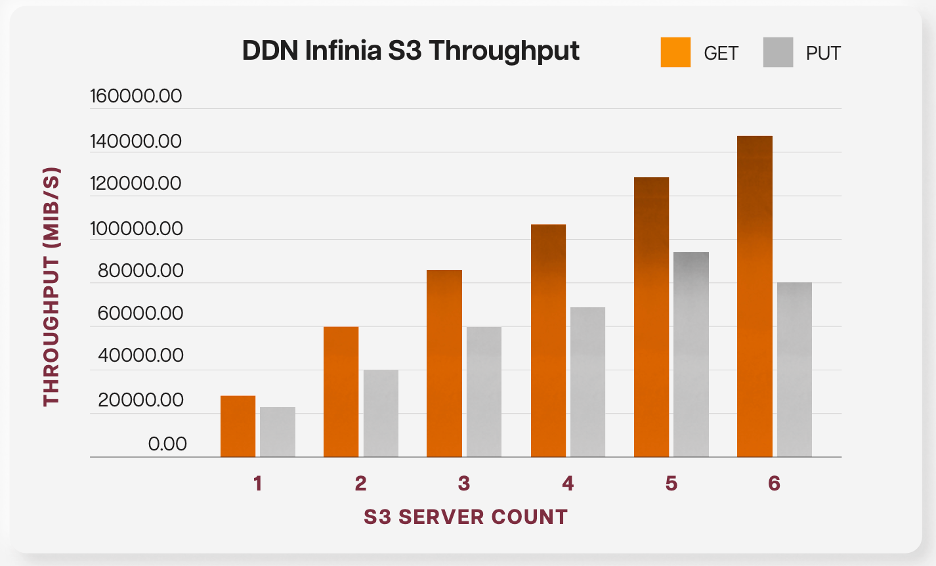
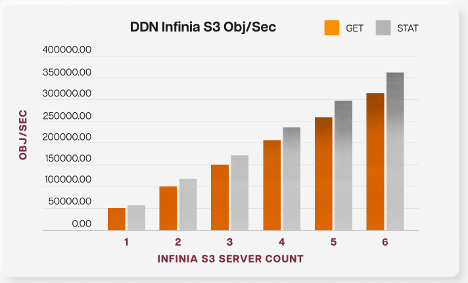
As servers were added, performance scaled with each node without degradation. Customers can move from pilot to production without rebuilding the architecture.
What Better Utilization Is Worth
In VentureBeat’s Q1 2026 AI Infrastructure & Compute Market Tracker, the share of buyers naming cost per inference and total cost of ownership as a top priority rose from 34% to 41% in a single quarter, overtaking performance as the dominant procurement lens. Cisco’s 2025 AI Readiness Index points the same way. The 13% of organizations it classifies as fully AI-ready are four times more likely to move pilots into production and 50% more likely to report measurable value, while 64% of organizations still struggle to centralize their data.
Depreciation and operating costs continue regardless of utilization. Better data delivery can help organizations extract more work from the accelerators they already own.
The Value of an Answer Is When It Arrives
Every decision has a window in which acting on it can still change the outcome. The business sets that window, not the technology.
In financial services, the market sets it. In manufacturing, the production line does. In healthcare, the constraint may be more subtle — not merely a slow answer, but an incomplete one assembled from whichever systems happened to be reachable.
That changes the infrastructure conversation. Instead of starting with how many GPUs an enterprise owns, start with the decision it needs to make sooner. How is that decision made today? Where does the necessary information live? Where does the waiting occur? If success brings more data and users, the architecture must scale with them.
For the bank at the beginning of this story, a better model alone would not solve the problem. The answer had to arrive in time to inform the decision.
That’s what DDN and Cisco have designed around: Cisco UCS for the compute and server foundation, Cisco Nexus One for the fabric, and DDN Infinia for the data. The system feeding it determines whether an answer arrives while it can still change the outcome.
DDN is the data engine powering the AI economy. With Cisco, it now runs on infrastructure enterprises already know how to operate. One architecture, moving AI from installed capacity to productive output. That’s the machine that feeds the machine — and DDN and Cisco have built it together.
For Cisco, DDN, and channel partners: bring the data platform into your next AI customer conversation. Coordinate a joint discovery session around the business outcome the customer needs to achieve.