

What 600 Leaders Reveal About Building the Foundation for AI Success
As organizations move from AI pilots to production, they’re uncovering four pressures that weren’t visible before: rising infrastructure complexity, cloud environments stretched by new workloads, unexpected power and cooling demands, and operational skill gaps that slow day-to-day progress. These realities are creating a clear divide between teams that advance and teams that stall—driven by choices about architecture, operating model, and where to invest next.

What’s Holding them Back
- 98% face a skills gap related to AI infrastructure
- 93% are working to reduce AI’s energy footprint
- 65% say their AI environments are already too complex
- 54% delayed or cancelled an AI project in the past 24 months
“We face challenges every day and must learn to deal with them — integration, scalability, being able to adapt… AI is such that we are learning every day.” – IT decision maker, Pharma/Life Sciences

What Successful AI Teams are Doing
- 97% say cloud is essential to scaling AI
- 72% of enterprises are working with partners to build and run AI infrastructure
- 63% have begun consolidating or modernizing their environments to reduce complexity
- 57% improved time-to-results after modernizing AI data pipelines
Explore the strategies helping teams build AI that scales and adapts to what comes next.
“AI is fundamental to our future. Our struggle is scaling the workloads.” — IT Decision Maker, Public Sector

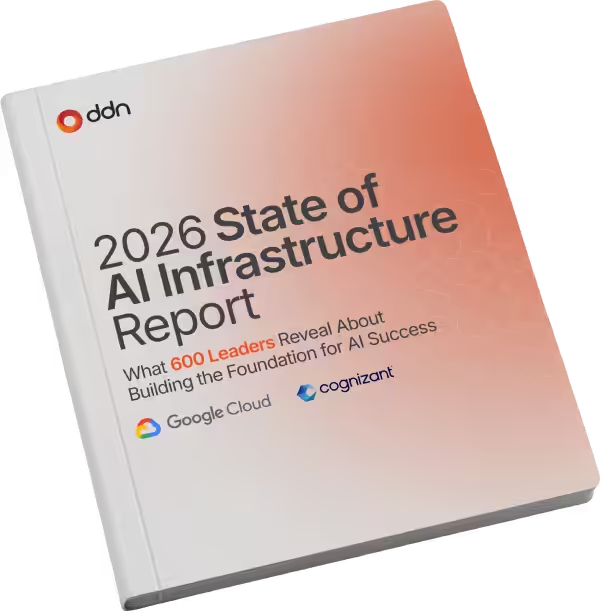

Download 2026 State of AI Infrastructure Report
Get the complete findings, data visualizations, and recommended actions from all 600 respondents.
Learn MoreAI Infrastructure Has Become the Make-or-Break Factor
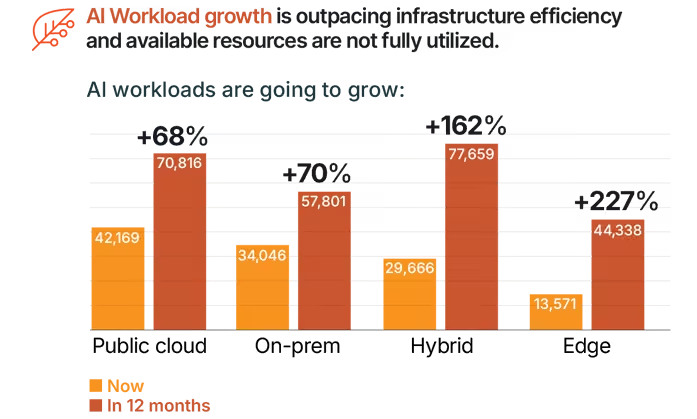
AI workloads strain traditional environments. Most systems weren’t built for distributed data, multimodal concurrency, or continuous inference — and complexity has become the #1 drag on AI ROI.
What the Data Shows
- 65% report excessive infrastructure complexity
- Complexity leads to 3+ month delays in time-to-value
- 54% have postponed or cancelled AI initiatives
Winning Formula: Leaders simplify, consolidate, and build unified data access — not additional layers.
Cloud Is the Fastest Path to Early, Predictable AI Outcomes
Cloud has become the default starting point for AI — not because it’s the final answer, but because it removes the biggest early blockers: access to GPUs, variable scale, fast experimentation, and ease of iteration. Teams starting in cloud report smoother onboarding and fewer early failures.

What the Data Shows
- 97% say cloud is critical to scaling AI
- 70% use cloud for AI data operations
- 69% use cloud for AI experimentation and development
Winning Formula: Leaders use cloud to break complexity early and accelerate time-to-results.
“Cloud is needed to scale and optimize. Get your cloud provider onboard at the beginning of the AI journey. They’ve done this before — use their expertise.” — IT Decision Maker, Public Sector
AI Is Exposing Power, Cooling, and Efficiency Gaps That Block Progress
AI introduces power and thermal demands that most infrastructure budgets and facilities were never designed for. Energy consumption, cooling capacity, and inefficient data movement have become real operational constraints — often limiting progress long before compute capacity or GPU availability. These gaps are already impacting deployments today, driving up costs and reducing the return on new AI investments.

What the Data Shows
- 93% are actively working to reduce AI’s energy footprint
- 65% of infrastructure sits idle while still consuming power
- 47% cite energy and cooling as their top inefficiency
- Only 41% report efficiency gains from recent investments
Winning Formula: Leaders treat power and efficiency as first-order design requirements — maximizing utilization and eliminating waste before it compounds.
“Reduce your costs and carbon footprint by investing in energy efficiency of your infrastructure.” – Business decision maker, Consumer Services
Download 2026 State of AI Infrastructure Report
Get the complete findings, data visualizations, and recommended actions from all 600 respondents.
Learn MorePartnerships Are the Force Multiplier Behind AI Success
The most successful organizations aren’t trying to operationalize AI alone. They’re combining internal expertise with proven ecosystems — cloud providers, GSIs, platform partners, and specialists — to reduce risk, accelerate deployment, and build repeatable AI operating models. Partnership isn’t a dependency. It’s a structural advantage.

What the Data Shows
- 98% report AI infrastructure-related skills gaps
- 72% rely on partners for architecture or operations
- Partnership-led teams see fewer performance bottlenecks and stronger operational momentum
Winning Formula: Leaders rely on expert ecosystems — not isolated teams — to achieve sustainable AI outcomes.

Download 2026 State of AI Infrastructure Report
Get the complete findings, data visualizations, and recommended actions from all 600 respondents.