
Nebul is a European NeoCloud that runs AI workloads for organizations whose data has to stay inside Europe. DDN Infinia sits underneath Nebul’s inference stack and stores the model’s working notes, known as the key-value (KV) cache, where the whole GPU fleet can reach them. That makes inference faster, because the fleet restores context instead of rebuilding it. It makes inference more resilient, because a replaced GPU can pick up where the last one left off. And it makes inference more efficient, because fewer GPU cycles go to repeated work.
Why Data Residency and Operational Control Matter to Nebul Customers
Consider a software company whose platforms support the digital operations of municipalities across the Netherlands. As AI becomes part of those applications, model inference has to meet the same requirements as the software itself: sensitive data must remain under control, workloads need enterprise-grade security and observability, and the infrastructure has to operate within European boundaries.
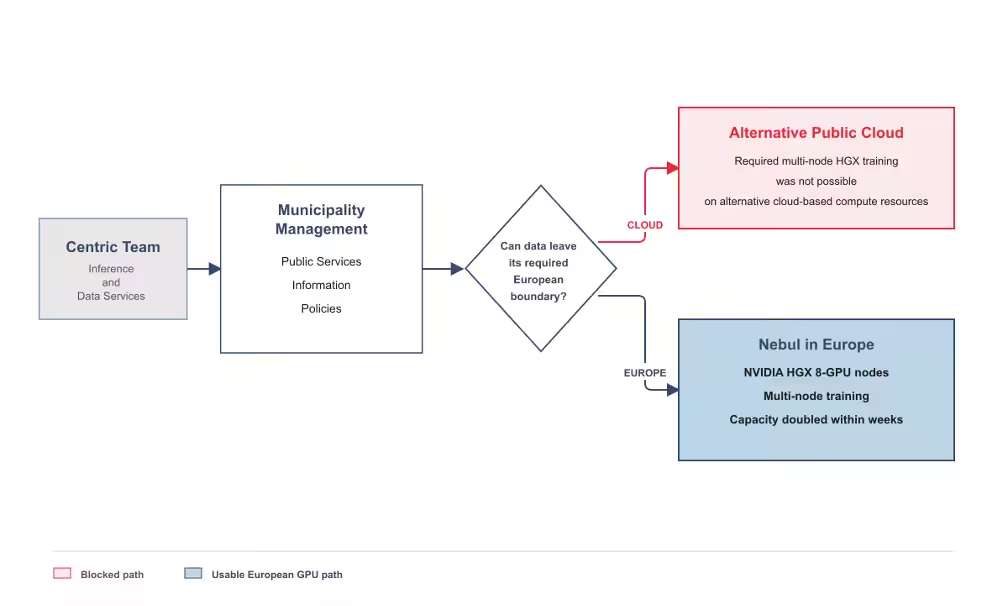
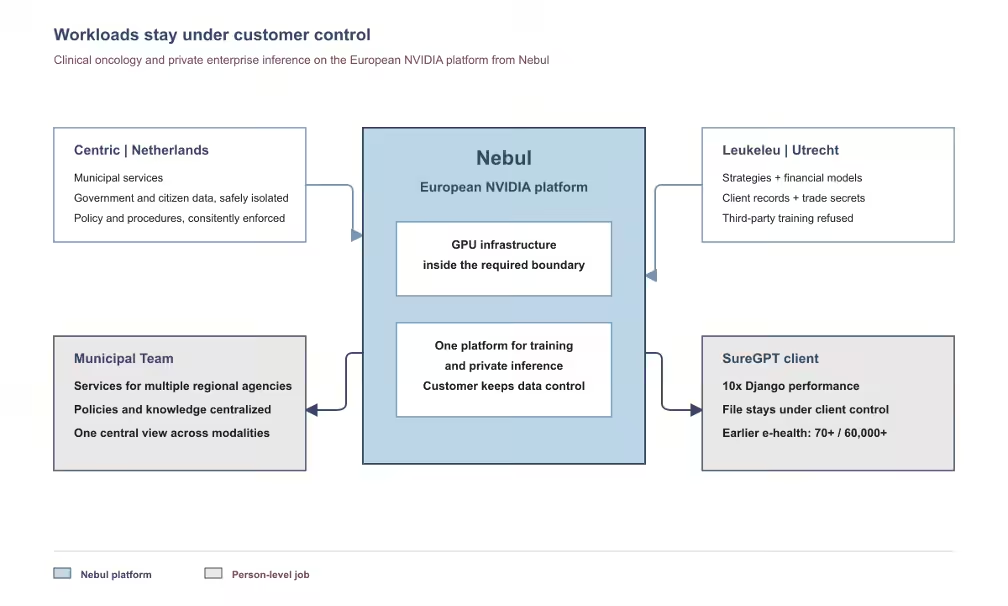
Centric is one of those companies. Its software supports approximately 70% of Dutch municipalities. Centric uses Nebul to run sovereign AI model inference, combining European AI infrastructure with the security, control and operational visibility required for public-sector environments.
Now picture a software firm in Utrecht. Its clients want a private AI assistant that can answer questions about their own internal documents, including board strategies, financial models, product roadmaps, and the trade secrets sitting next to them. They won’t upload those files to a third-party model when they have no say over who holds the data or how it’s used afterward. Alongside model quality, these customers need clear controls over where their data is processed, who can access it and how it may be used.
Both organizations need AI infrastructure that meets their workloads’ data-location, access and security requirements. For workloads that require processing within Europe, those requirements extend beyond the GPU servers to stored context, supporting databases, and relevant operational data. Customers also need clear terms governing access to their documents and prompts and whether that information can be reused for AI training. Nebul provides the European infrastructure; DDN Infinia supports the storage and reuse of inference context to reduce repeated processing.
Nebul Provides European Infrastructure for Production AI
Nebul provides European cloud and AI infrastructure for organizations that need to build and run AI while maintaining control over their data, models and workloads. Its NVIDIA-powered infrastructure provides the accelerated computing foundation for both AI training and production inference, while keeping workloads within the geographic and operational boundaries customers require.
Centric Runs AI Inference on European Infrastructure
Netherlands-based Centric is a leading IT and software company whose solutions support approximately 70% of Dutch municipalities. As Centric integrates AI into its software and services, customer requirements extend beyond where application data is stored. They also concern where models run, who can access the data and cached context, and how those resources are managed.
Centric uses Nebul to run sovereign AI model inference on European infrastructure with enterprise-grade security and observability. This allows AI capabilities to be integrated into software serving public-sector environments without giving up control over where workloads and data are processed.
For workloads like these, inference performance is only part of the requirement. Isolation between customers, visibility into the infrastructure and predictable behavior under production load are equally important. That becomes particularly relevant when multiple customers share the same underlying GPU infrastructure.
The Same shows up at Leukeleu, the Utrecht software firm. Nearly 15 years ago, the company ran a sovereign e-health platform that served more than 70 healthcare organizations and more than 60,000 patients in the Netherlands. Those figures come from that earlier platform and predate Nebul. Today, its SureGPT service is built around the objection its commercial clients still raise: they won’t upload their files to someone else’s model. Its SureGPT service runs on Nebul’s NVIDIA-powered infrastructure. Nebul supplies the European GPU infrastructure, while Leukeleu provides the application interface, data preparation and integration. Leukeleu reports 10x performance gains in data-heavy Django applications on the platform, including lower latency and better reliability. That is Leukeleu’s application result, not an internal DDN benchmark.
What Happens After the Model Is Trained
European hosting addresses the location requirements of these workloads. Production inference must also deliver responsive service under load.
During inference, the model stores intermediate representations of previously processed tokens in a key-value (KV) cache. This avoids repeating calculations as it generates an answer. Reusing compatible cached context across requests can also reduce repeated prompt processing and time to first token. For an illustrative municipal document-assistance workflow, lower latency could help staff retrieve more relevant information more quickly during their work.
When the KV cache is not available, operators and customers see that loss firsthand in a few places. Concurrent sessions compete for time to first token. A GPU node fails or goes offline for maintenance, and the notes that lived only on that box are lost. High Bandwidth Memory (HBM) fills up, the cache evicts aggressively, and recent long context is gone before today’s follow-up arrives.
Nebul’s customers also share the same European fleet, so reuse can’t come at the cost of leaking context between tenants. Centric and a SureGPT client can share storage hardware. Shared infrastructure must keep each customer’s cached context isolated from other tenants.
Once residency is solved, this is the problem that remains. The records stay in Europe, but the GPU time spent reading them is wasted unless the fleet can find those notes again.
Where Nebul Stores the Notes So the Fleet Can Reuse Them
This is where DDN Infinia comes in, as the storage layer under Nebul’s serving stack. Infinia stores and restores KV cache blocks as data the whole fleet can reach, not as a private copy stuck on one GPU server. Tenant, subtenant, and dataset scope live in the key namespace on the same physical system. That is how isolation stays attached to every restore.
Cache Eviction Helps Manage Capacity
Capacity only helps if the fleet doesn’t stall the moment a dataset fills up. On most systems, once a storage tier runs out of room, something must give: new requests queue up, sessions get rejected, or inferencing pauses while space is cleared.
At Nebul, Infinia handles this differently: cache data eviction is a built-in policy at dataset and tenant scope, not a stop-the-world event. When a dataset approaches capacity, Infinia evicts according to the First In First Out (FIFO) policy. Inferencing continues uninterrupted instead of blocking cache pressure. A municipal application’s multi-turn session and a software client’s document session can run different eviction behavior on the same physical system, and neither one stalls the other out when it fills up.
That is the intelligent part operators can already plan for: eviction as a continuous, policy-driven background process tied to tenant and dataset, not a disruption that pauses inference while the fleet catches up
The Key Outlives the GPU
The KV cache blocks live in Infinia, not only in HBM or host memory on the GPU box. So a replaced or rescheduled GPU can pick up from previously generated state instead of rebuilding the full context. After an outage or maintenance window, the architecture still changes the question. It is no longer whether the GPU has to rebuild the context, but whether the key is still there to restore.
The cheapest token is the one the fleet doesn’t have to recompute. Restoring KV blocks instead of rebuilding the same context spends fewer GPU cycles on repeated prefill work. That is how context reuse turns into more tokens per second on a fixed rack. Once a team has timed restore against rebuild on its own traffic, it can close the loop on power and cost. DDN hasn’t published a tokens-per-watt or tokens-per-dollar series for this collaboration. The only published timing is the restore result.
What the Restore Proved
On NVIDIA infrastructure at Nebul, DDN reports token responses with Infinia nearly 10x faster than the same workloads without a KV-cache fabric, and up to 5x faster than alternatives. The result covers short prompts through large-token contexts under concurrent demand. It isn’t a Centric timing or a SureGPT measurement. The collaboration continues, with current work extending the tested sequence lengths.
Figure 3 shows the restore flow. The GPU server asks for the block. Infinia returns it under the tenant key into GPU HBM, or into host Dynamic Random Access Memory (DRAM) and then to HBM. If the key is missing, the GPU computes and rebuilds the context itself.
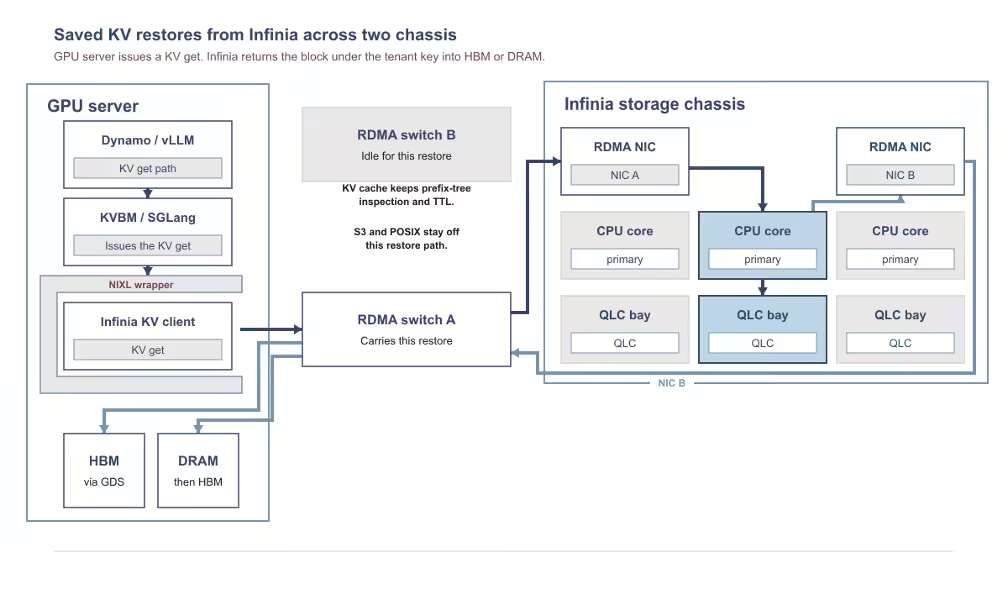
On Nebul’s platform, DDN Infinia keeps the part of inference infrastructure that would otherwise be repeatedly recomputed. The context generated from processing prompts and data becomes a shared service that can be restored across the GPU fleet while remaining isolated by tenant.
For organizations such as Centric and Leukeleu, production AI requirements extend beyond where data is stored. They include where models run, how cached context is accessed and retained, and how workloads remain isolated on shared infrastructure.
By preserving and reusing compatible cached context, Nebul and DDN can reduce repeated prompt processing on NVIDIA-powered infrastructure, supporting more responsive and more efficient production inference.